
After nearly five years of working at a small San Francisco-based general contractor (GC), Assistant Project Manager Cibele Ortiz was feeling stuck.
In honor of Women in Construction Week (WiC Week), we’re spotlighting five outstanding women selected by the Women of Webcor (our employee resource group for women, open to ALL Webcorians) leadership committee who have made exceptional contributions to Webcor while embodying our core values.
She was anxious to take on new challenges at a larger, more established GC and support more complex projects, but she wasn’t sure where. As she researched the companies behind some of her favorite buildings in San Francisco, however, the answer became clear: a California-focused commercial contractor called Webcor.
She decided to ask her former colleague, a retired union carpenter who knew her and her work history well, for his honest opinion: Did she have what it took to succeed at a large GC like Webcor?
“He looked at me kind of sadly and said, ‘No, they’ll eat you alive,’” she recalls. She submitted her application anyway.
Weeks later, she was standing at the Grand Hyatt at SFO project site as one of Webcor’s newest project engineers (PEs). After about a year, she was promoted to senior PE while wrapping up the Grand Hyatt, which went on to win the Design-Build Institute of America’s (DBIA’s) National Award of Excellence in 2020.
Shifting From Design to Construction
Cibele studied architecture at the California College of the Arts (CCA), an art school that emphasizes craft and delivery as much as design. After graduating with her Bachelor of Architecture, she worked for architecture firms as a designer for almost six years.
Around that sixth year, she realized she was beginning to outgrow her career path. She wanted to do more than design—she wanted to bring those designs to life.
She soon landed a job as a bench carpenter operating a computer numerical control (CNC) at a custom woodwork shop, where she stayed for a few years before pivoting to project management at a small GC. There, she realized that as much as she excelled at and enjoyed architecture and design, she clearly loved construction more.
“In architecture, we work inside our minds, which makes the work feel quiet and solitary,” she says. “Construction is more tangible and collaborative, and the energy from everyone working together on the project is livelier. It doesn’t hurt that construction pays better too!
“However, I do think both fields attract people who see their work as a passion—not just a job.”
Of course, that’s not to say she isn’t still working her architectural muscles. Her design background has positioned her as a uniquely effective collaborator who understands and appreciates architects’ vision and goals. “Hopefully, they see me as a partner instead of an adversary!”
Lessons Learned at Webcor
As an assistant project manager, Cibele now approaches every issue knowing the best thing she can do is something—even if it’s not the perfect move. She no longer lets the fear of making a mistake intimidate her into freezing up. When faced with a problem, waiting around for a solution isn’t helping anyone.
She’s also learned the immeasurable value of listening and observing. When people take the time to truly absorb what others are saying instead of talking over one another, she says, a clear path forward often emerges.
These types of hands-on, real-life lessons learned on the job have been the most rewarding part of her Webcor experience. Fortunately, she knows plenty more are ahead at UCSF Health Helen Diller Hospital—a life-changing project that’s become the most gratifying accomplishment of her career.
“I’ll always be proud of my contributions to HDH,” she says. “It’ll be standing tall and taking care of people long after I’m gone.”
Building a Long-Term Career at Webcor
It’s been almost 15 years since Cibele left the architecture world to figure out her next move. Today, she’s grateful to say she’s never been more confident about the direction her career’s headed and hopes to stay with Webcor for many years to come.
Beyond her own career advancement, though, Cibele recognizes that moving up in this industry is a win for all women who are underestimated, dismissed, and questioned for daring to work in construction.
“Being underestimated is a near-universal experience for us,” she says. “But our success is even more gratifying when it proves the doubters wrong!”
Recently, she ran into the retired union carpenter who had once said Webcor would “eat her alive.” “When I saw him, he’d already heard I’d joined Webcor,” she says. “He was so proud of me!”
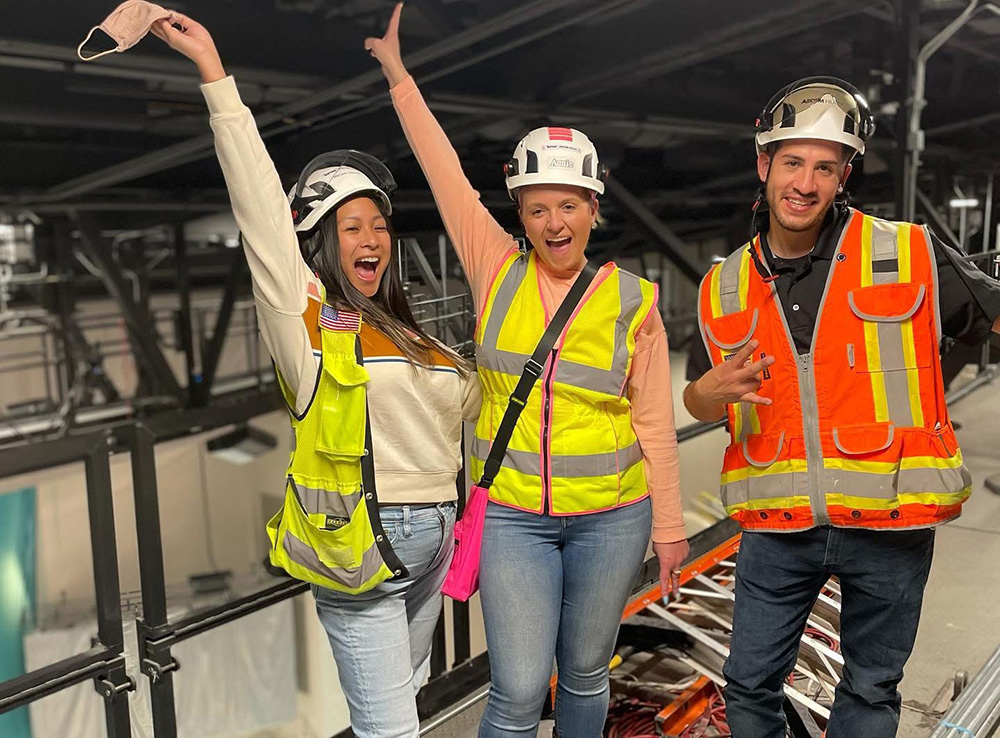
Annie Eismeier didn’t start her career with a hard hat or a Revit model.
In honor of WiC Week, we’re spotlighting five outstanding women selected by the Women of Webcor (our employee resource group for women, open to ALL Webcorians) leadership committee who have made exceptional contributions to Webcor while embodying our core values.
Her journey began in the world of fine arts and fashion design — a background that might seem a world away from a construction site, but one that provided the foundational creativity she uses every day as a Virtual Design and Construction (VDC) Manager at Webcor.
After a college internship in the fashion industry, Annie realized the environment lacked the steady, reliable atmosphere she was looking for. She shifted gears, taking a receptionist role at an interior design firm to test the waters in architecture. That move sparked a series of transitions: from receptionist to marketing coordinator, and eventually to a marketing role at Turner Construction in New York.
"I enjoyed marketing a lot, but the only challenge was the time — I was constantly cranking out proposals and graphics," Annie recalls. Seeking something more operations-based, she accepted an on-the-job training offer for VDC.
The Universal Language of Problem-Solving
Transitioning into VDC was a "tech challenge" of the highest order. Working in Revit and managing trade coordination on-site required Annie to master complex MEP (mechanical, electrical, and plumbing) systems without a traditional engineering background. "When I first started on-site, I really didn't have the engineering background a lot of people do," she says. "It was another level of 'wow.' But over time, I learned what I needed to."
Her strategy was simple and direct: she admitted what she didn't know and sought help from the experts in each trade. "My style was just to admit I didn't have the knowledge and to look for all the help I could get. I had experienced people from each trade helping me learn."
This humility led her to discover that the construction industry has a remarkable capacity to accommodate people with diverse skill sets. "What's very cool about this industry is that there's room for people with a lot of different educational backgrounds. Problem-solving,” she says; “anyone can be good at that."
Finding Culture and Stability at Webcor
Annie moved to Los Angeles seven years ago and joined Webcor four years later, after stints at other major firms. For her, the move to Webcor was driven by a desire for genuine connection. At previous firms where the home office was out of state, there was often a sense of isolation.
"I wanted to work somewhere more California-based. At my previous firm, the main office was in Arizona, and I felt disconnected," Annie explains. "Webcor is absolutely different. People are very friendly; it's a different culture."
That culture has provided a sense of stability that Annie found lacking elsewhere. "Coming to Webcor felt more like having a history with the company — with the leaders and the people I worked with on projects," she notes. Her current work extends into ACC (Autodesk Construction Cloud), where she is helping to build formal training programs. "SMEs get so busy with their day jobs," she says. "I'm working on a program for that. It allows me to meet more people and get involved with more workflows than the typical VDC tasks."
A New Normal for Representation
When Annie started her career in New York, women were a small minority—perhaps six out of a team of 70. Today, she often finds herself in meetings where women outnumber men. On the San Benito Student Housing project at UC Santa Barbara, for instance, the entire dedicated trade coordination team was composed of women. She has observed past industry attempts to "artificially" balance teams — such as assigning women specifically to hospital projects or women’s colleges — but Annie views the organic presence of women in leadership as the ultimate goal.
"At other GCs I worked at, there were no women in roles as senior as (Sr. VP) Allison McCue or (VP) Kamika Kilgore," she says. "It doesn't surprise me now; it seems par for the course.
“Women should be in these roles,” she says. “It should just be normal." For Annie, the focus remains on the quality of the work and the support found in the day-to-day environment. "It's important to be around women who are supportive every day."
Finding a Personal Style in the Field
As a self-described "shy and quiet" communicator, Annie has had to find her own voice in an industry often characterized by outgoing, assertive personalities. "I have to find my style for communicating with men who may not be expecting to see me there or are not used to working with a shy woman," she explains. This internal navigation is as much a part of the job as the software she masters.
Her advice to the next generation? Don't wait for a "roundabout path" if you can find your way to STEM early. "I wouldn't recommend that path if they could decide earlier," she admits. "There was a time I was questioning my decisions, wondering what my career path would look like." However, she has demonstrated that a background in art can be the perfect precursor to a career in digital construction. "When I was studying art, my dad tried to encourage graphic design because it was the 'practical' art, but I didn't like computers back then. Then I switched, and I started loving them."
Whether she is organizing luncheons for a hundred women in the trades or refining virtual models, Annie’s focus is on the human element of the build. "You have to find your own style to fit with the team and get along with people," she says. In the end, the most sophisticated software in the world is only as good as the communication between the people using it.
If you know Agueda Zarate, you know she doesn’t have time to waste.
In honor of WiC Week, we’re spotlighting five outstanding women selected by the Women of Webcor (our employee resource group for women, open to ALL Webcorians) leadership committee who have made exceptional contributions to Webcor while embodying our core values.
Her natural style of communication feels tailor-made for construction: direct and to the point. No meaningless pleasantries; no dancing around awkward topics.
In our industry, this type of unapologetic (yet respectful) straight talk is not only expected, but applauded—especially when coming from men leading field teams. But for women in administrative roles, the expectations have never been quite the same.
“My intent is always to be efficient and clear, so I’m very direct but never ill-willed,” Agueda says. “It can be jarring to those who don’t know me and assume I’ll be more feminine or softer in my delivery simply because of my gender and/or role.”
Jarring or not, Agueda’s too busy to beat around the bush. Don’t let her senior executive assistant (EA) title fool you—her responsibilities extend far beyond managing executives’ calendars and coordinating travel arrangements.
“If people don’t know me personally, it’s easy for them to undermine my impact at Webcor,” she says. “I may be sitting at the front desk answering the phone with one hand, but that doesn’t mean I’m not negotiating a vendor contract to keep our overhead costs down with the other.”
Getting Started in Construction
Like many in our industry, Agueda was exposed to construction at a young age. After she and her family moved to the U.S., her parents learned English while taking on odd jobs—one of which was painting.
When she turned 16, she joined her dad at the painting subcontractor he’d been working for, where she primarily entered invoices and estimates. They continued working there together every summer until she left for college, and her dad went on to start his own company painting residential homes.
As she began her job search, her partner at the time (an architect) encouraged her to consider the general contractor side. After Googling LA’s top contractors, she learned Webcor was in the top five—and happened to be looking for a project accountant. She knew she had to apply.
After a couple weeks of silence, she assumed the opportunity wasn’t meant to be. At the same time, she was working with a recruiting company to support her job search—and the first interview they secured her was for a temporary front desk position at Webcor’s LA office.
From the start, Agueda was determined to make herself indispensable. Her responsibilities quickly evolved from basic front desk tasks to office management and executive support (while still maintaining the front desk), culminating in her recent promotion to senior EA in LA Operations and office manager of our LA corporate office.
Being a strategic partner to executives remains her top priority—proactively identifying needs, creating structure, and always staying one step ahead.
Tackling Challenges & Building New Skills
Claiming to “wear many hats” can feel cliché—but if anyone’s earned the right to say it, it’s Agueda.
“Every day brings a new adventure,” she says. “I could be coordinating a volunteer event one day, building out an office another, taking photos at one of our jobsites the next, and running financial reports, all while plotting calendars and travel logistics for different team members.”
In 2023, Agueda took on the toughest project of her career: managing the completion of our downtown LA (DTLA) office build-out and move into the new space. She had her work cut out for her—she had no formal project management training or experience moving into an office of that size, and the LA office’s former general manager and design manager had just left Webcor, so minimal support was available.
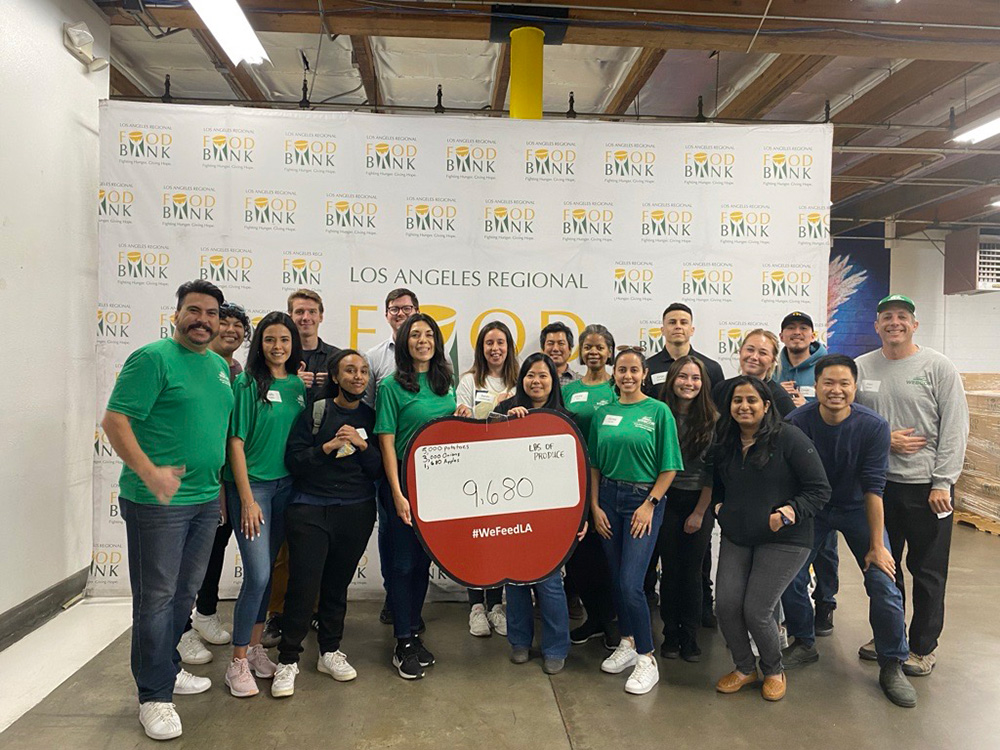
From the start, Agueda envisioned an office that fostered a real sense of community—her favorite Webcor core value (did we mention she’s also been Webcor LA’s unofficial volunteer event planner for the last eight years?). She pictured an inclusive space that welcomed not only Webcorians, but our summer interns and local high school students from our community partnership programs like ACE Mentor Program and DTLA’s Ketchum YMCA.
“We want to bring in young talent and make Webcor a fun, challenging, great place to work,” she says. “I really enjoy seeing their growth and being part of their journey with us.”
No one’s growth has filled her with quite as much pride as Ricardo Rosales'. In 2022, Agueda interviewed Ricardo and decided to offer him an internship at the front desk—an opportunity to demonstrate his work ethic and strategic thinking skills, just as she had four years earlier.
Reflecting on the trajectory her own career has taken, Agueda’s realized she truly can accomplish anything she sets her mind to. Every time she’s doubted herself, she’s delivered—thanks in no small part to her well-honed problem-solving skills, proactive mindset, and general self-sufficiency.
“There have been so many moments when I really did not think I’d be able to pull off some of the challenges assigned to me,” she says. “Thankfully, our leadership has always given me the trust and autonomy to figure it out.
What’s Next?
Over the last eight years, Agueda’s balanced her EA workload with venturing into Marketing and Project Accounting and managing a TI buildout—valuable opportunities that exposed her to entirely new worlds within Webcor.
However, nothing has brought her greater satisfaction or benefited more from her exceptional organizational skills and razor-sharp attention to detail than EA work. “I can say with certainty that I’ll always be in or around the EA role,” she says.
Unsurprisingly, she’s already on top of her next move—experimenting with AI to automate more routine processes and exploring ways she can support other critical business functions.
Juggling such a wide variety of responsibilities with so many groups/people could easily overwhelm some—but not Agueda. If she’s learned anything about herself over the last few years, it’s that she thrives in the chaos of EA life: tight deadlines, unexpected challenges, and competing priorities.
“Change is our only true constant,” she says. “In construction, at Webcor, and in life, you just have to roll with it!”


